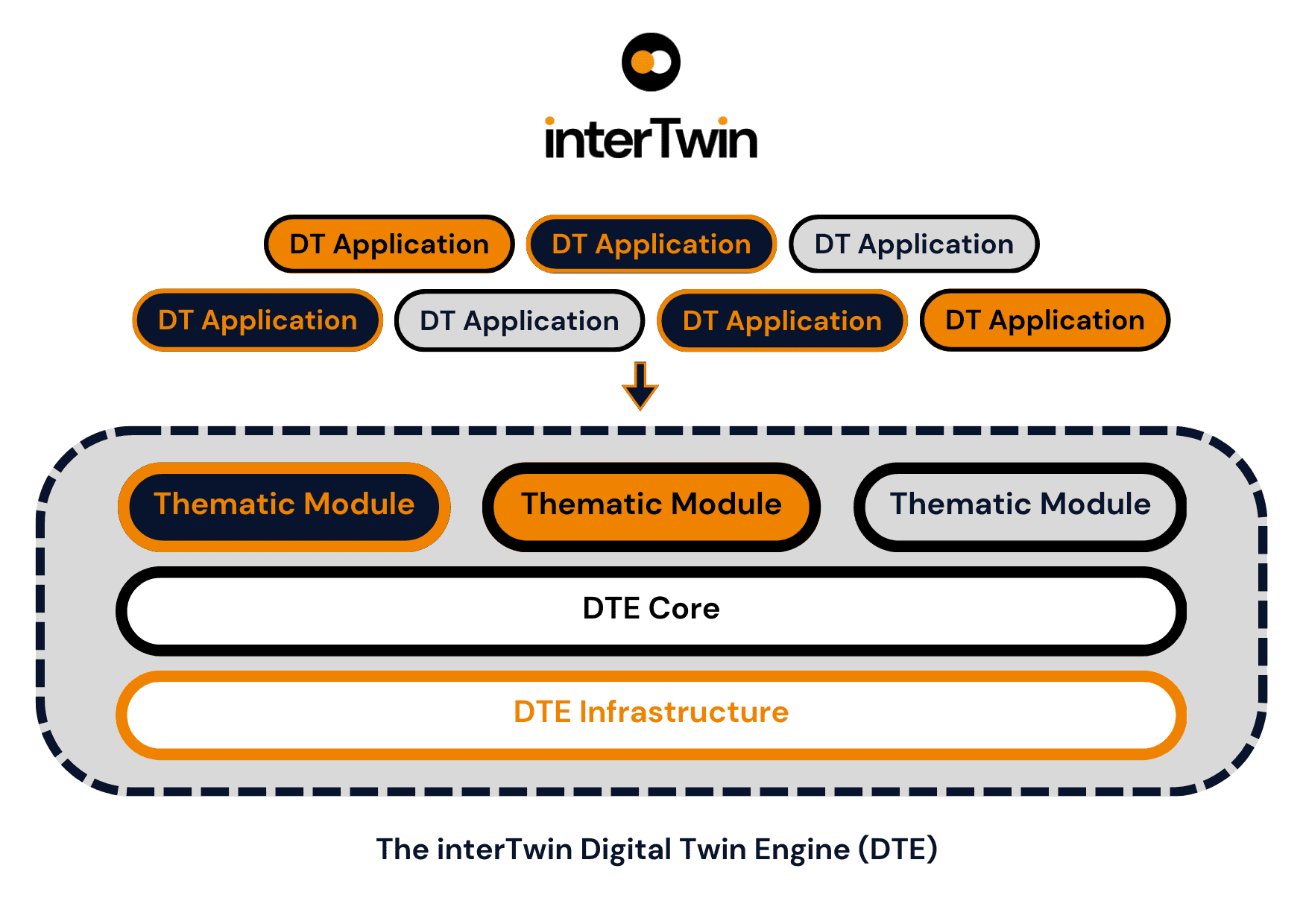
The interTwin interoperability framework aligns technical approaches and foster collaboration in modelling and simulation application development across scientific domains. It includes an architectural blueprint for the interTwin Digital Twin Engine, outlining its functional specifications, requirements analysis, and fundamental building blocks. Additionally, it takes into account other relevant initiatives like Destination Earth and the interoperability aspects, highlighted also by the piloting and integration activities achieved.
Key Exploitable Result
Interoperability Framework: Guidelines, Specifications, and Blueprint Architecture
The interTwin interoperability framework aligns technical approaches and foster collaboration in modelling and simulation application development across scientific domains.

Exploitation Path
Further Research / Collaborative Projects:
Collaboration with DT-Iliad and DT ocean and Cross-project collaboration with BioDT, DT-GEO and DestinE for the creation of a joint european glossary on digital twins,
Standardization Activities:
Contribution to the creation of the Working Group from IEEE for the Standardization of DT of the Earth, in collaboration with DT Iliad, The creation of the WG was formally accepted under IEEE-SA P3501 working group – Recommended Practice for the Development of Digital Twins of the Earth and kickstarted in January 2025.
Alignment with interoperability standards, e.g. CWL, (as described in D3.4), OGC standard is in the process of incorporating openEO as community standard, has been getting feedback from the community in March and April 2025.
Interoperability with DestinE, Data Spaces and EOSC has been tested along the use cases explained in D3.7.
Alignment with EOSC Interoperability Framework (as described D3.5) include EOSC core-services (AAI, Accounting, Monitoring, Helpdesk & Configuration Database), EOSC Compute Federation (Hybrid cloud orchestration, workload management & software distribution) and EOSC Exchange (e.g. Notebooks, PaaS Orchestrator, AI/ML Integration and Scalable Big Data Tools). Use case has permitted to test the integration of a Digital Twin in EOSC EU Node
Technology Transfer/ Licensing:
Some of the interTwin DTE components are expected to be evaluated under DestinE (also thanks to the activities in follow up projects such as RI SCALE). In particular the DataLake and the AI Framework.
Part of the Interoperability assessment with EOSC, interTwin Core services and components TOSCA templates and Configuration artifacts are available to be executed at EOSC EU Node.
Open Science:
All deliverables are made available open access via multiple channels such as interTwin managed web pages, and Zenodo. A scientific publication has been prepared describing the overall interTwin framework and it is expected to be published short after the end of the project
Details
Target Groups
+
- DT Developers interact with interTwin DTE, seen as PaaS (Platform as a Service), developing DT applications and occasionally thematic modules tailored to the needs of specific user communities
- DT Infrastructure Providers provide computational resources and storage, to build and run the DTs and eventual connectivity with the physical twin existing in the real world
- DT Users access the DTE as a SaaS (Software as a Service) via the DT Applications developed by the DT developers. An end user can choose an “out of the box” DT application and connect it to its use case (physical twin) or configure the needed parameters for their experiments
Access
+
Deliverables openly available via Zenodo under a CC BY 4.0 license
Maintenance and Support
+
Valorisation / Exploitation Path
+
Open access available via multiple channels such as EOSC and AI4EU, interTwin website, and Zenodo.
Ownership
+
Details
Target Groups
+
- DT Developers interact with interTwin DTE, seen as PaaS (Platform as a Service), developing DT applications and occasionally thematic modules tailored to the needs of specific user communities
- DT Infrastructure Providers provide computational resources and storage, to build and run the DTs and eventual connectivity with the physical twin existing in the real world
- DT Users access the DTE as a SaaS (Software as a Service) via the DT Applications developed by the DT developers. An end user can choose an “out of the box” DT application and connect it to its use case (physical twin) or configure the needed parameters for their experiments
Access
+
Components offered under Free and Open Source Licenses
Ownership
+
The DTE is owned by EGI Foundation, the different components & modules are owned by each of the partners having generated them.
Maintenance and Support
+
Every component owner has their own policies.
Next Steps
+
Collecting feedback for the second release to be published (D5.4, 6.4, 7.7 and 7..8 -expected January 2025) and final deliverable D3.6 -expected in March 2025)
Towards the end of the project it is expected to complete the different components and complete the integration of the different modules WP5 and WP6 are integrated with the Thematic Modules and used in the Use Cases.
Documentation
Related project deliverables